
Stanford's 2026 AI Index Report: A Striking Portrait of Global Artificial Intelligence

Every year, Stanford University releases a document that has become the global benchmark for taking stock of where artificial intelligence stands. The 2026 AI Index Report, newly published by the Stanford Institute for Human-Centered Artificial Intelligence (HAI), is no exception: its hundreds of pages deliver an independent, rigorously sourced review of a technology that, far from plateauing, keeps picking up speed.
For anyone looking to cut through the hype, this report is essential reading, and this blog post distills the key findings from the 2026 AI Index Report, so you can get the big picture without having to wade through all 423 pages of the original.
What stands out most in the 2026 AI Index Report is the widening gap between what these models can do, the economic value they generate, and the speed at which regulatory, ethical, and environmental frameworks are struggling to catch up. Here are the big takeaways to help you make sense of it all.
AI capabilities aren't plateauing, they're accelerating
Contrary to the popular notion that AI has hit a ceiling, the data tells the opposite story. In 2025, private industry produced over 90% of notable frontier models. Several of them now match or exceed human performance on PhD-level science questions, multimodal reasoning, and competition-level mathematics.
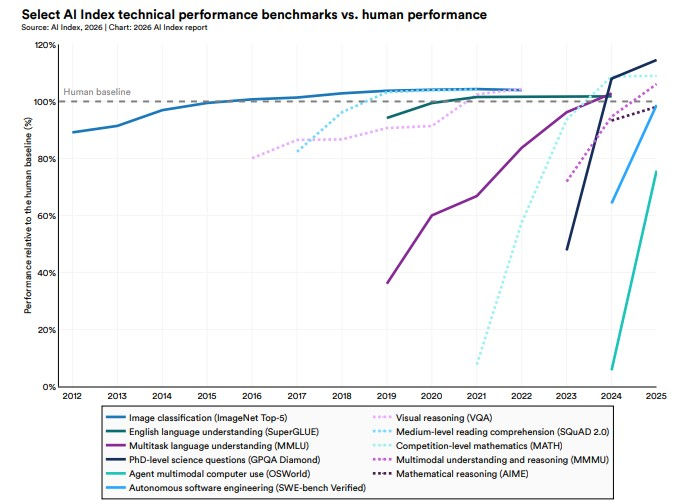
The most striking example comes from coding. On SWE-bench Verified, a leading benchmark, performance jumped from 60% to nearly 100% of the human baseline in a single year. Organizational adoption has reached 88%, and 4 out of 5 university students now use generative AI.
Yet these same models can win a gold medal at the International Mathematical Olympiad while being unable to reliably read an analog clock more than 50% of the time. Researchers call this the "jagged frontier", AI that's brilliant on some tasks, surprisingly limited on others.
Record adoption, massive economic value
Generative AI has reached 53% population adoption in three years, outpacing both the personal computer and the internet at their peak. The United Arab Emirates leads at 64%, Singapore follows at 60.9%, while the United States ranks 24th at 28.3%. Canada lands in 14th place at 35% adoption, ahead of the U.S. but well behind European leaders like Norway (46.4%), Ireland (44.6%), and France (44.0%).
The financial figures are staggering. Global corporate investment in AI more than doubled in 2025 to reach $581.69 billion. OpenAI hit roughly $25 billion in annualized revenue by early 2026; Anthropic reached $19 billion. Google, for its part, announced more than $150 billion in annual capital expenditures to support its AI infrastructure.
Consumer value is also exploding: the U.S. consumer surplus from generative AI is estimated at $172 billion annually in early 2026, a 54% increase year over year. Median per-user value tripled between 2025 and 2026.
Organizational ROI: where AI actually pays off
Among the 88% of organizations that have adopted AI, the gains cluster in specific functions:
Biggest cost savings in software engineering and manufacturing (cited by 56% of respondents)
Biggest revenue gains in marketing and sales (67%), strategy and corporate finance (65%), and product development (62%)
Indirect value reported by 64% of respondents in the form of increased innovation, and by 45% through higher employee and customer satisfaction
A study of 12,000 European firms found that AI adoption boosted labour productivity by 4%, with gains significantly amplified when training accompanied the rollout. In the United States, productivity hit 2.7% in 2025, nearly double the average of the previous decade.
Researchers point to a "J-curve" effect: organizations first absorb the integration costs before the macroeconomic gains become visible in aggregate data. We seem to still be on the upswing.
The labour market is already shifting
In sectors where productivity gains are clearest like customer support and software development, studies report increases of 14% to 26%. But there's a flip side: among American developers aged 22 to 25, employment has dropped nearly 20% since 2024, even as headcount for more senior developers keeps growing.
The message for younger professionals is clear: the most automatable entry-level roles are the first to shrink. That's exactly the dynamic we explored in our post Translation and Artificial Intelligence: Shape the Future, Don’t Fear It, where personal strategy becomes a genuine lifeline.
AI that sometimes outperforms doctors
In clinical settings, multi-agent AI systems are now hitting up to 85.5% diagnostic accuracy on complex cases, compared to roughly 20% for unassisted physicians. Tools that automatically generate clinical notes from patient visits saw widespread adoption in 2025: some hospital systems report up to 83% less time spent on note-writing and significant reductions in physician burnout.
⚠ A word of caution, though: a review of more than 500 studies on clinical AI found that nearly half relied on exam-style questions rather than real patient data, and only 5% used actual clinical data. The promise is real, but the evidence base remains thin.
Safety isn't keeping pace
This is one of the most concerning findings in the 2026 AI Index Report: benchmarks for responsible AI are lagging significantly behind. Nearly every leading frontier model developer publishes its capability results, but responsible AI reporting remains patchy. The number of documented AI incidents climbed to 362 in 2025, and a far cry from the fewer than 100 per year recorded until 2022.

Even worse, recent research shows that improving one dimension of responsible AI — safety, for instance — can degrade another, like accuracy. There's no easy fix for this trade-off yet.
Geopolitics, sovereignty, and environmental footprint
The U.S. hosts 5,427 data centers, that's more than ten times any other country. A single Taiwanese company, TSMC, fabricates nearly every chip powering cutting-edge models, leaving the global supply chain uncomfortably concentrated.
Private U.S. investment in AI reached $285.9 billion in 2025, more than 23 times China's total. But the performance gap between American and Chinese models has almost closed, and a growing number of developing countries are rolling out national AI strategies to assert their sovereignty.
This race comes at a cost. Training emissions for Grok 4 are estimated at 72,816 tons of CO₂ equivalent. AI data center power capacity has hit 29.6 GW, comparable to New York State at peak demand. Annual water use for GPT-4o inference alone could exceed the drinking water needs of 12 million people.
Experts and the public: two worlds, two perceptions
Here's a striking finding: 73% of experts believe AI will have a positive impact on how people do their jobs, compared to just 23% of the general public. A 50-point gap. Similar divides show up on the economy and medicine.
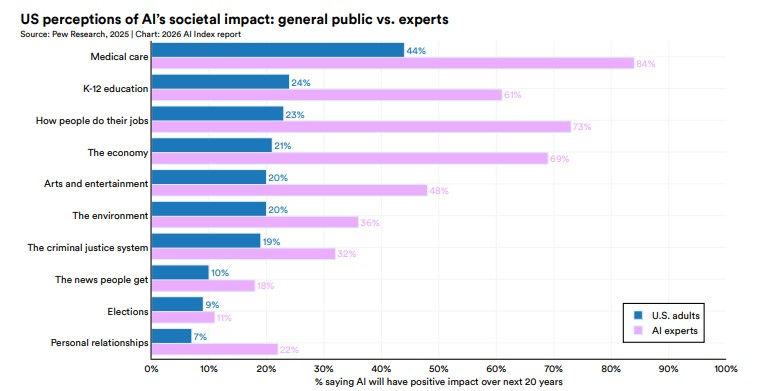
Globally, trust in governments to regulate AI varies. Among surveyed countries, the U.S. reports the lowest level of trust in its own government on AI regulation (31%). The European Union is viewed as more credible than the U.S. or China when it comes to effective AI regulation.
What the 2026 AI Index Report tells us about what's next
At its core, the 2026 AI Index Report sends two seemingly contradictory messages that nonetheless coexist. The first: AI is generating measurable, fast-moving, and significant economic value for both companies and individuals. The second: the frameworks that should be guiding this transformation — safety, regulation, training, environment — are falling dangerously behind.
For professionals, the challenge isn't picking a side. It's developing AI literacy that lets you seize opportunities without getting swept away or left behind. Adopting AI with open eyes means recognizing both its real power and its documented limits. That's also the very reason Info IA Québec exists.
Subscribe to our newsletter (published in French only) so you don't miss any upcoming analysis, and get a weekly AI recipe 🥗 to help you adopt AI, one practical tip at a time.

Natasha Tatta, C. Tr., trad. a., réd. a. Bilingual language specialist, I pair word accuracy with impactful ideas. Infopreneur and GenAI consultant, I help professionals embrace AI and content marketing. I also teach IT translation at Université de Montréal.


