
Google’s AI Ecosystem: Models, Tools, Agents and Applications
- Mar 11
- 5 min read
Updated: Mar 12
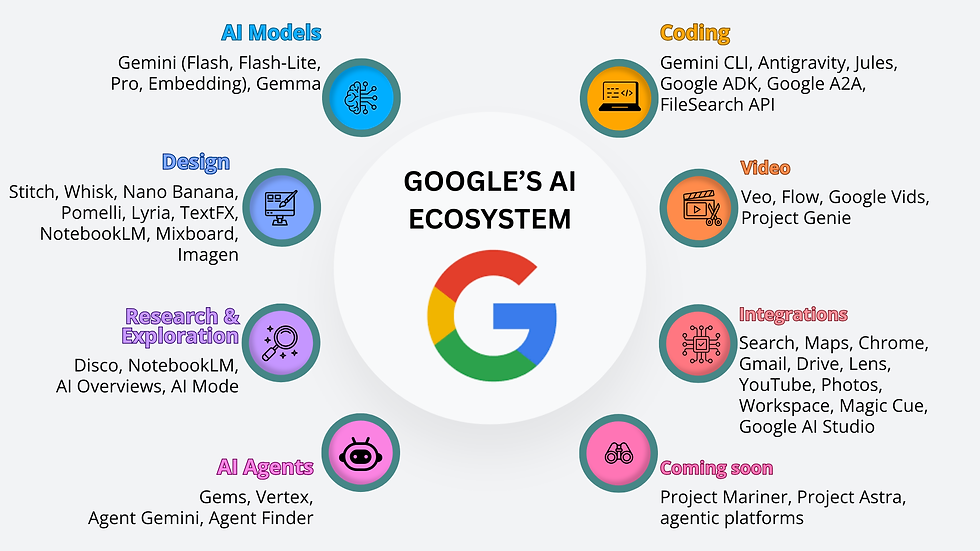
From Gemini models to autonomous agents, augmented search and creative tools, AI is now integrated across many of Google’s products. This article explores Google’s AI ecosystem, from foundation models to the tools designed for developers and everyday users. To see the full structure of this ecosystem, download the PDF, which includes links to all the tools mentioned (published in French only):
What Is Google’s AI Ecosystem?
Google’s AI ecosystem refers to the collection of technologies developed by Google to integrate artificial intelligence into its products, services and development platforms. This ecosystem is built on several complementary layers, ranging from foundational AI research to the tools used every day by millions of people.
It also relies on a powerful technological infrastructure, including Google Cloud platforms and specialized processors such as Tensor Processing Units (TPUs), which make it possible to train and deploy these models at scale. Some of these technologies are also embedded directly in devices, such as Pixel phones, where certain AI features can run locally.
At the core of this ecosystem is Google DeepMind, Google’s artificial intelligence research lab. DeepMind is responsible for many major advances in AI, particularly in reasoning models, multimodal systems and autonomous agents. Several of the models that power Google’s AI services today are developed within this organization.
What Is a Foundation Model in Artificial Intelligence?
A foundation model is an artificial intelligence model trained on extremely large volumes of data so it can perform a wide range of tasks. Rather than being designed for a single specific function, a foundation model serves as a base that can support or power many different applications.
These models are typically built using advanced neural network architectures and are pre-trained on massive datasets that may include different types of data such as text, images, audio or code.
Once trained, they can be adapted or used for a variety of tasks, including text generation, translation, image analysis, programming and information retrieval. Models such as BERT, GPT, LLaMA and DALL-E are well-known examples of foundation models. They represent a major shift in the development of artificial intelligence, as a single model can now serve as the foundation for many different applications.
However, they should not be confused with the AI tools people use every day. Tools such as Grammarly, DeepL, Midjourney, Copilot or Perplexity are not foundation models themselves. They are applications built on top of AI models.
Within Google’s AI ecosystem, these models play a central role. Google develops the Gemini family of models, which can understand and generate different types of information. This family includes Gemini Flash, optimized for speed, Gemini Pro, designed for more advanced reasoning, and Gemma, a family of open-source models intended for developers and researchers. Together, they power many of Google’s AI products and services.
Artificial Intelligence Tools Developed by Google

Beyond AI models themselves, Google also offers a range of AI-powered tools designed for content creation, information analysis and idea exploration.
For example, NotebookLM can analyze and synthesize information from multiple documents, while tools such as Stitch, Whisk and Nano Banana help generate user interfaces, images or visual concepts.
An experimental tool such as Disco can transform web browser tabs into interactive applications, enabling you to interact with the content of a web page in a more dynamic way. Other tools, such as TextFX and Lyria, enable users to experiment with creative writing or AI-assisted music creation. Together, these tools illustrate how artificial intelligence can be used not only to answer questions, but also to create, prototype and produce content.
Google’s AI Agents
A new generation of AI tools does more than simply answer questions. They can plan actions and complete tasks. An AI agent is an artificial intelligence system capable of planning steps, accessing different sources of information and carrying out certain tasks autonomously, often by using multiple tools or applications.
Another important component of Google’s AI ecosystem involves these agents. Unlike conversational systems such as Gemini, which mainly respond to user queries, AI agents can organize tasks and execute them with varying levels of autonomy.
Google is developing several technologies in this area, including Agent Gemini, which can combine web browsing, research and interactions with different applications. Platforms such as Vertex AI also allow organizations to create and deploy their own AI agents based on their internal data.
Google Gems are customizable assistants that users can configure within Gemini to perform specific tasks, similar to OpenAI’s custom GPTs. A Gem can be designed to analyze documents, assist with programming, summarize information or generate content. These specialized assistants rely on Gemini models but are tailored to a particular purpose. These systems represent an important shift: AI is no longer limited to generating responses. It can also take action and perform tasks. To better understand the different levels of autonomy in AI tools, read this article.
AI Integration Across Google Products

One of the most striking aspects of Google’s AI ecosystem is how artificial intelligence is now directly integrated into everyday products used by billions of people. Rather than existing as a separate tool, AI is gradually becoming a technological layer embedded across many digital services.
In Google Search, for example, AI now generates information summaries through AI Overviews, which provide structured answers directly within search results. This shift is changing how users discover and understand information online.
In Gmail, artificial intelligence helps users write and reply to emails more efficiently by suggesting context-aware text.
The Chrome browser also integrates AI-powered assistance features that can analyze web pages and help users complete certain tasks.
Applications such as Google Maps rely on AI to offer contextual recommendations and guidance while navigating.
Artificial intelligence is also embedded in Google Workspace, where it assists users in Google Docs, Sheets, Drive and Meet to write, analyze data and organize their work.
Finally, Google is developing platforms that allow users to experiment directly with its AI models. One example is Google AI Studio, an environment designed to simplify the creation, testing and integration of AI-powered applications.
Google AI Studio: Experimenting with Google’s AI Models

Among the tools designed for developers and creators, Google AI Studio plays an important role in Google’s AI ecosystem. This platform allows users to quickly explore and test ideas using models from the Gemini family. It provides a simple interface to experiment with different types of prompts, adjust model parameters and observe responses in real time.
Google AI Studio also serves as a prototyping environment. Developers can design applications, test interactions with the models and generate code that enables them to integrate these capabilities into their own projects.
AI Is Already Changing How We Use Technology
Google’s AI ecosystem reflects a broader shift. Artificial intelligence systems are no longer isolated tools. They are becoming a technological layer integrated into nearly every digital service. Search, creation, programming, communication and productivity are gradually converging toward a new type of interface: systems capable of understanding human intent and responding accordingly.
✨ AI is evolving rapidly. To stay up to date and discover emerging tools, practical guides and the latest developments, subscribe to the Info IA Québec newsletter (published in French only).

Natasha Tatta, C. Tr., trad. a., réd. a. Bilingual language specialist, I pair word accuracy with impactful ideas. Infopreneur and GenAI consultant, I help professionals embrace AI and content marketing. I also teach IT translation at Université de Montréal.


